
Smarter Shopify is our series designed to give Shopify business owners practical, honest insights into AI without the hype. In Part 1, we looked at the AI tools already sitting inside your Shopify admin. Now we’re zooming out, because while you’ve been running your business, the search landscape has shifted significantly beneath your feet.
In the first part of this series, we talked about how AI is quietly reshaping what happens inside your Shopify store. This time around, we’re looking at what’s happening outside it, focusing on the place most of your potential customers start their journey – Google.
If your organic search traffic has dropped noticeably over the past year and you’re not sure why, you’re not alone. Google has fundamentally changed and understanding it is no longer optional for anyone selling online.
The Search Page You Knew Is Gone
Cast your mind back to what a Google results page used to look like. Ten blue links, maybe a few ads at the top, and your position in that list was everything. Good SEO meant climbing that list. Simple enough.
That’s not what people see now. Open Google and search for almost anything, and the first thing you encounter is likely to be an AI-generated summary sitting at the very top of the page.
Google calls these AI Overviews, and they represent the most significant change to how search results are displayed in decades.
The AI Overview reads the top results, cherry picks key information, and presents it directly on the page without the user needing to click anywhere.
For informational searches when a question is posed, it presents the answer right there. No click required. Which means no visit to your site.
The Traffic Drop Is Real
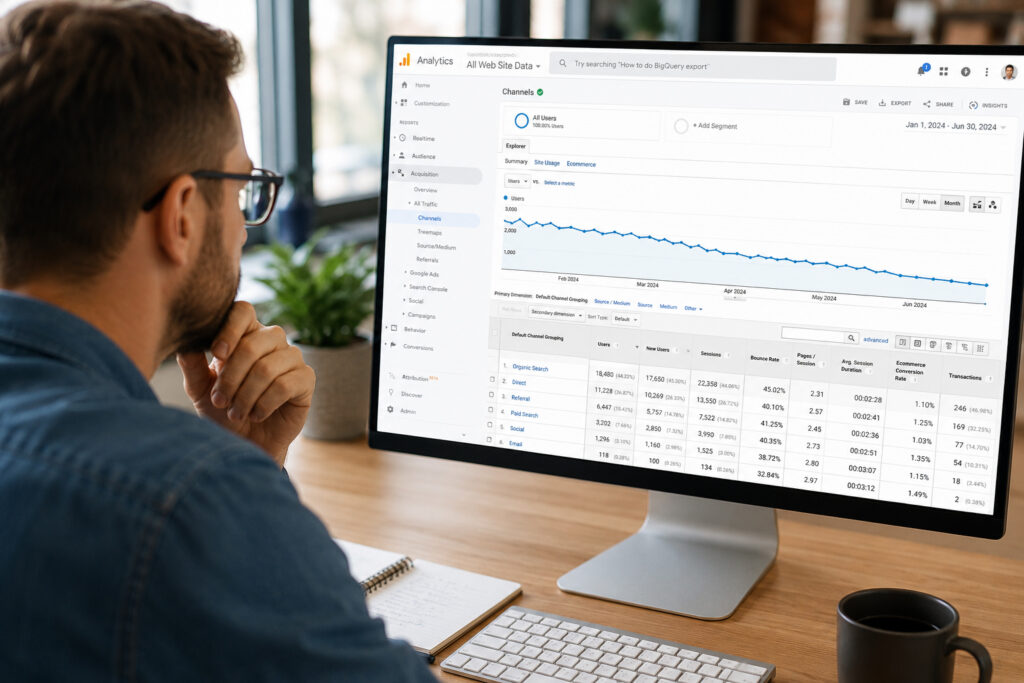
Businesses across almost every sector are reporting meaningful declines in organic search traffic despite ongoing SEO and maintaining or even improving their search rankings. You might still maintain a top of the page position in organic search and yet receive a fraction of the clicks you used to.
The data behind this is still emerging, but the pattern is consistent enough that the SEO industry has had to fundamentally rethink what success looks like. Ranking well is still important, arguably more important than ever, but ranking alone is no longer the whole picture.
The irony is that AI Overview usually pulls information directly from the pages they’re effectively replacing. If you’re a trusted authority, your content might be informing Google’s answer. Just without the traffic to show for it.
Move Over SEO, AEO Is The New Kid In Town
Traditional SEO is about helping search engines find, crawl and rank your content. Answer Engine Optimisation or AEO is all about structuring your content so that AI systems can understand it, trust it, and cite it.
AEO is not a replacement for SEO, but it does add an extra layer of complexity to it. Search engines and AI systems are increasingly behaving like answer engines rather than index engines.
When someone asks a question, whether on Google, in a voice search, or increasingly using tools like ChatGPT, Microsoft Copilot or Google Gemini, the system is looking for content that’s clearly structured, demonstrably authoritative, and directly answers the question being asked.
The businesses that are currently doing best in this new environment are the ones whose content is built around this shift rather than older models of keyword density and link volume.
Ranking well is still important though, and it’s arguably more important than ever when we talk about trust and authority signals, but ranking alone is no longer the whole picture.
What Hasn’t Changed
Before SEO starts to feel like it’s no longer relevant, it’s worth being clear – the fundamentals of good SEO absolutely have not changed but they have become even more important.
Google still rewards content that’s genuinely helpful, useful and relevant to the person searching. It still values sites that load quickly, work properly on mobile and are easy to navigate, so those Core Web Vitals are still important. It also still uses backlinks as a signal of trust and authority. The technical foundations of SEO matter as much as they ever did.
What’s changed is getting those fundamentals right used to be enough to compete, but AEO adds more complexity to the picture. How well structured your content is, how clearly it answers real questions, how authoritatively it positions your brand – this is more important than ever.
What This Means for Your Shopify Store
For Shopify stores, these are three key areas to consider in terms of AEO.
Product page content
Product pages that were written primarily to rank for a keyword are increasingly struggling. AI systems surface product information in overviews and shopping features when the page itself gives them enough to work with – clear specifications, genuine descriptions that answer questions, structured in the right way.
Your product page needs to do even more heavy lifting now, so consider doing things like pulling in product specific reviews and FAQs into your pages, expanding product descriptions in a meaningful way and adding as much detail as possible is what’s required.
Structured data and schema markup
This is technical and happens behind the scenes, but it’s important. Schema markup is a way of categorising page content so that search and AI systems can better understand that content.
Google uses this information to power rich results like the star ratings, pricing and availability details you sometimes see directly in search results.
For Shopify stores, having schema implemented correctly is one of the clearest ways to signal authority to both traditional search and AI systems. It’s also one of the areas most commonly done partially or incorrectly, which means the information Google has about your products could be incomplete.
Brand authority signals
AI systems are increasingly drawing on signals of brand authority and expertise when deciding whose content to surface and cite. This plays directly into the kind of work we’ve always believed in, building brand websites that have a consistent voice, clear positioning and content that demonstrates genuine expertise.
If you’ve read our thoughts on brand consistency, much of what we said there applies here in a new context. A brand regarded as credible and coherent to a human reader is likely well positioned to be treated as a trusted source by AI.
The Bigger Picture
The changes happening in search right now are genuinely significant and they’re not finished yet – AI Overviews are still evolving. The way Google surfaces ecommerce content is shifting and new AI-powered search tools are growing in use, particularly among younger audiences.
None of this means panic, but It does mean paying attention and making active adjustments to your content strategy is something that needs to be an immediate priority.
Our SEO and digital marketing services have always been grounded in doing things properly rather than using short-term tactics. This approach matters even more, because the businesses that will hold their ground are the ones with strong foundations, clear brand authority and content that’s been built for the benefit of people rather than algorithms.
If your traffic has dipped and you’re not sure why, or if you want to understand what your SEO should look like in 2026, we’re happy to help. Your time is best spent doing what you do best, running you business. We’re here to help your business remain relevant in a rapidly changing landscape.